Flop House
- 4.5
- Rating
- 10.00M
- Installs
- Free
- Price

 Analysis by App-foxy
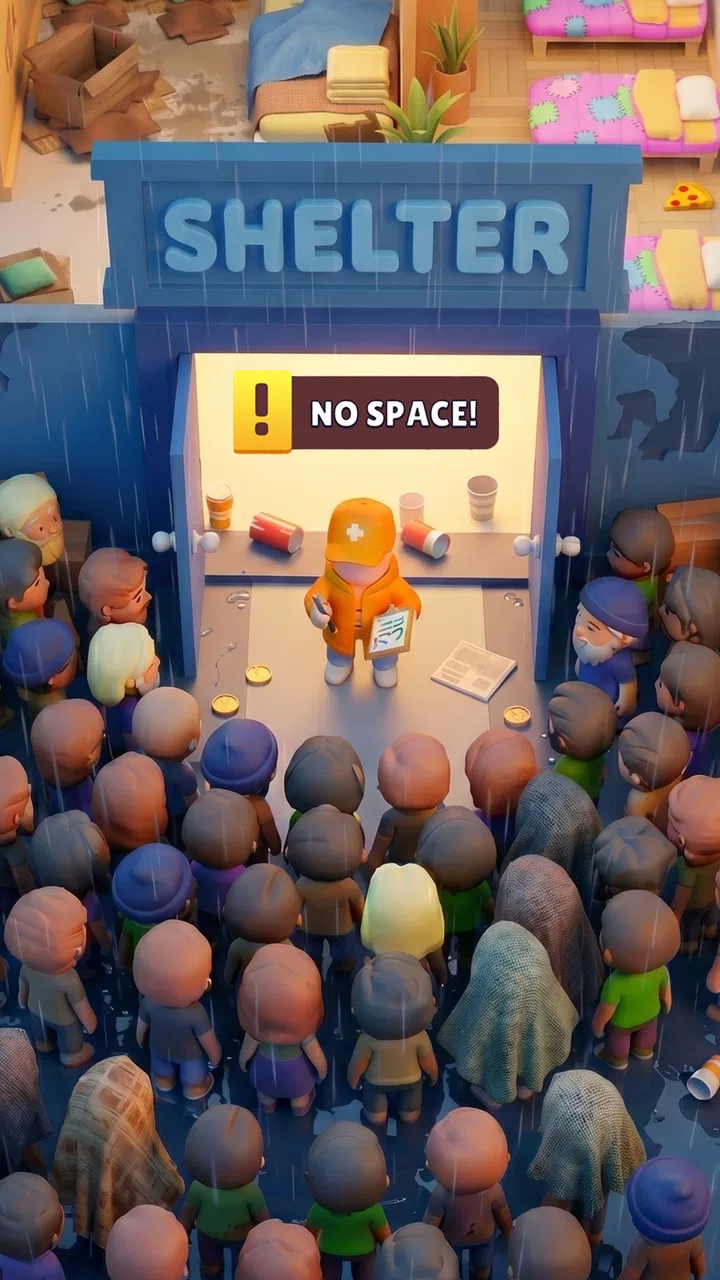
Flop House caught my attention because it turns a serious subject into a compact management game. I step into the role of running a homeless shelter, improve the space, support the people staying there, and try to keep the operation moving while progress continues in the background. That setup gives it a warmer identity than the usual shop, restaurant, or city-building simulation, even though it still uses familiar idle-game rhythms.
Developed by CrazyLabs LTD, the game is free to start and sits in the simulation category. It has reached over ten million installs and holds a 4.4 average from around eighty-nine thousand ratings, which suggests that the simple loop has connected with a large audience. I would not treat those figures as a guarantee that everyone will enjoy it, but they do reflect a game that is easy to understand and broadly approachable.
What the first week feels like
The opening hours are the strongest part of the experience. Flop House gives me a clear purpose almost immediately: make the shelter function better, improve the conditions, and help residents move toward a more stable situation. The theme makes each upgrade feel more meaningful than simply increasing the income of a fictional business. Even when the actions are straightforward, the context gives them emotional weight.
You May Also Like

 Blood Strike: 2.5 Anniversary
Blood Strike’s Loadouts Turn Every Drop Into a Tactical Gamble
A close look at Blood Strike’s custom loadouts: how fast access to signature weapons reshapes its battle royale rhythm, rewards preparation, and narrows the gap between fights.

 Pandora - Music & Podcasts
Pandora’s Music Is Easy to Start, but Harder to Recover
Pandora’s strength is its low-effort path from a seed to a station. Its weak spot is how much confidence it asks you to place in connection, setup, and quiet recovery.

 8 Ball Pool
 Is Built on Rivalries, Rematches, and Routine
A close look at the rivalries, rematches, shared routines, and unanswered safety questions that turn a quick pool match into a persistent mobile community.

 Samsung Music
’s Quiet Strength Is Playing What You Already Own
Its reach comes less from spectacle than from dependable access to a personal library. That simplicity is both the app’s strongest retention engine and its ceiling.

 AccuWeather: Weather Radar
AccuWeather Review: A Quick, Clear Forecast for Everyday Decisions
For everyday plans, the best forecast is the one you can understand quickly. AccuWeather makes rain timing, radar, and local conditions easy to act on, with a few trade-offs.

 Hill Climb Racing
Why Hill Climb Racing Still Turns Crashes Into One More Run
A tiny car, a bumpy hill and one more upgrade: Hill Climb Racing keeps resurfacing because its simple chaos makes every near-miss feel personal.
More From Our News Desk



The game is built for short sessions. I can check the shelter, collect progress, choose an improvement, and leave without needing a long uninterrupted block of time. That makes it a natural fit for a commute, a short break, or the few minutes before bed. The idle structure also means I do not have to stare at the screen constantly. Returning after some time away usually feels like checking on an ongoing project rather than starting from zero.
That accessibility is important because the game does not ask me to learn a dense set of systems before I can enjoy it. The early decisions are readable, and the visual presentation keeps the shelter’s condition easy to follow. I can usually tell what needs attention without opening several layers of menus. For someone who likes simulation games but dislikes complicated spreadsheets, this is a comfortable entry point.
My best first-week approach was to resist spending every reward immediately. I looked at which improvement would remove the biggest bottleneck rather than choosing the most attractive upgrade. In an idle game, a small increase to the part of the shelter that limits progress can be more useful than a larger-looking improvement elsewhere. That habit made the early loop feel less random and gave each visit a clear reason.
The subject matter also changes how I read the game’s feedback. A cleaner, better-equipped shelter is not just a higher score on a screen; it represents a more welcoming environment. I still understand that this is a simplified game, not a realistic model of homelessness or social services, but the framing encourages me to think about the consequences of upgrades instead of treating them as decoration alone.
There is a gentle sense of responsibility in the first sessions. I am not simply building a profitable business. I am balancing improvement with the practical need to keep the shelter operating. That distinction gives Flop House its most memorable quality, especially for players who are tired of simulations that reduce every goal to earning more virtual money.
It is also worth being clear about the audience. The content rating is Teen, and the theme may be more emotionally serious than the cheerful presentation suggests. I would recommend it to older children and adults who can appreciate a fictionalized management scenario, but not to someone looking for a completely carefree toy-like experience. The game is accessible, yet its subject deserves a little more thought than a typical idle clicker.
Why the novelty works
In the first week, the contrast between the shelter’s starting condition and its improved state supplies much of the motivation. Visible progress is satisfying because the setting feels personal. I notice the difference between merely accumulating currency and using that currency to make a place more functional. That connection is the main reason I kept returning after the initial curiosity.
Another useful detail is the way idle progress supports irregular play. I do not need to maintain a perfect daily streak to feel that the shelter is advancing. This makes the game less demanding than many competitive mobile titles, where missing a session can leave me permanently behind. Flop House is better suited to relaxed personal progress than to players who want rankings, pressure, or constant optimization.
Still, the early appeal depends heavily on the steady arrival of new improvements. The first stretch feels active because each visit tends to reveal something to work toward. If I play for a long continuous session, the simplicity becomes more obvious. The game is at its best when I let it occupy small spaces in my day instead of trying to consume it all at once.
What remains after the first month
The more important question is whether the shelter remains interesting once the initial transformation is no longer new. In my experience, the answer depends on what I want from a simulation. If I enjoy gradual upgrades, light resource planning, and the satisfaction of checking a project over time, Flop House can remain a pleasant routine. If I need deep strategy or a constantly changing challenge, the loop may feel thin well before a month has passed.
Its month-to-month value comes from repetition with a purpose. I return, collect what has accumulated, decide where the next improvement matters, and watch the shelter develop. That cycle is easy to fit around real life, but it is not especially demanding. The game offers a calm sense of continuity rather than a large number of radically different scenarios.
I found it more rewarding when I treated each session as a small planning exercise. Instead of tapping through every available action, I asked what would improve the next few visits. Should I prioritize faster progress, a more useful facility, or a general improvement that supports several parts of the shelter? Even modest choices feel more satisfying when I give them a reason.
This is where the game compares favorably with many ordinary idle simulations. A typical idle business game often asks me to maximize revenue with little emotional connection to the result. Flop House gives the same basic convenience but places it inside a setting where the outcome feels more human. That does not automatically make the mechanics deeper, but it does make the routine easier to care about.
On the other hand, players who prefer management games such as detailed city builders, colony simulations, or economy-focused tycoon titles should lower their expectations. Those alternatives usually provide more interconnected systems, more room for failure, and more meaningful trade-offs between competing priorities. Flop House is designed for clarity and accessibility, not for a complex simulation of shelter administration.
The game is also a better choice for casual players than for people who want a complete offline hobby in one package. Its value grows through repeated brief visits, so it works best alongside other games rather than replacing them. I would keep it on my phone as a low-pressure management option, not as the only simulation I play.
How to make the routine last
A practical way to extend its life is to create a simple return rhythm. I might check in during a morning break, make one deliberate upgrade, and leave rather than spending every available resource in a rush. This keeps the shelter’s development spread across the day and preserves the feeling that I am managing an ongoing place. The game loses some of its charm when I turn it into a frantic race through every menu.
I also recommend deciding in advance whether the goal of a session is progress or inspection. During a progress session, I spend resources on the improvement that best supports the next stage. During an inspection session, I simply review the shelter and collect idle gains without forcing a purchase. Separating those two habits reduces impulsive decisions and makes the idle structure feel more intentional.
For a realistic everyday scenario, imagine having five minutes while waiting for an appointment. Flop House fits that window well: I can open it, see what the shelter has produced, choose a priority, and close it without losing the thread. A more involved simulation might punish such fragmented attention, while this one is comfortable with it. That convenience is a genuine part of its long-term appeal.
Where maintenance becomes a burden
The same idle design that makes Flop House convenient can also create maintenance fatigue. The game expects me to return regularly enough for the background progress to matter, but not so often that every visit feels urgent. Finding that balance is easy at first. Over time, the routine can start to resemble a chore if I am opening the game only to collect rewards and repeat the same upgrade decision.
That is the central trade-off: the shelter keeps moving without constant attention, but the hands-on decisions may not always keep pace with that movement. Idle games often provide the illusion of activity through accumulating resources. Once I recognize that pattern, I need to decide whether the gradual transformation still feels rewarding on its own.
Free access lowers the barrier to trying it, but the presence of in-app purchases from $1.99 to $49.99 per item changes how I evaluate the long-term loop. I can begin without paying, which is useful for testing whether the theme and pace suit me. However, anyone sensitive to spending prompts should approach the purchase options carefully and decide on a personal limit before the game’s progression creates pressure.
My advice is not to buy simply because a timer or slow stretch makes progress feel less exciting. First, close the game and return later. The idle format is supposed to support patience, and a short break can reveal whether I genuinely want to accelerate the experience or merely dislike waiting in that moment. If the game is only enjoyable when progress is purchased, that is a sign it may not deserve a regular place on the phone.
Maintenance also includes attention rather than money. I need to remember what I was improving, understand which resource matters next, and decide whether another session is worthwhile. The interface helps keep the basic loop readable, but no idle game can remove the repetition entirely. Flop House is easy to maintain compared with a demanding strategy game, yet it still asks for a recurring habit if I want to see substantial development.
Small frictions that add up
The first friction is the limited depth of the central routine. Once I understand the basic relationship between collecting progress and improving the shelter, there are fewer surprises. That is not a flaw for a relaxing game, but it does mean the experience can flatten for players who need fresh mechanics every time they return.
The second is the emotional tension between the theme and the simplified idle structure. The shelter’s residents give the game a meaningful frame, but the management actions remain streamlined and game-like. Some players will appreciate that accessibility; others may feel that the subject deserves a more nuanced treatment. I see Flop House as a light fictional interpretation, not an educational or realistic guide to homelessness.
The third is the temptation to confuse activity with strategy. Tapping, collecting, and upgrading can feel productive even when the decision itself is obvious. I get more value when I pause and choose a priority, but the game does not always force me to think deeply. Players seeking complex planning should choose a fuller management simulation instead.
There is also a potential fatigue point in the contrast between short sessions and long-term goals. Brief visits are convenient, but they can make progress feel fragmented. A player who wants a strong sense of completion in one sitting may find the experience too incremental. Conversely, someone who enjoys checking a project over several weeks may find that gradual pace relaxing.
Who should keep it installed?
I think Flop House is a good fit for someone who wants a gentle idle simulation with a distinctive social setting. It suits players who enjoy watching a place improve, prefer low-pressure sessions, and like having a clear upgrade path without learning a complicated economy. It is especially appealing if ordinary restaurant or shop managers feel interchangeable and you want a theme that gives the routine a little more emotional character.
It can also work for families choosing a game for a Teen-rated player, provided the subject is discussed in an age-appropriate way. The game presents homelessness through simplified management, so it may prompt useful conversation without pretending to explain the real causes or solutions. I would not use it as a substitute for factual education, but its premise is more thoughtful than many casual mobile simulations.
I would skip it if I need competitive play, elaborate construction, deep customization, or a story that changes dramatically from one session to the next. I would also skip it if repeated reward collection feels like work, or if I dislike games that encourage regular check-ins. In those cases, a premium simulation with a defined campaign or a more complex city-management game would probably offer better lasting value.
The current version is 4.4.3, and the minimum operating system requirement is Android 7.0. That makes it accessible to many older Android devices, although the real experience will still depend on how well a particular phone handles modern mobile games. Since it is free to start, I would test it on the device I plan to use before considering any purchase.
One useful way to judge it is to ignore the first burst of progress and ask a simple question after several visits: do I still care which improvement comes next? If the answer is yes, the shelter’s theme is doing meaningful work for me. If the answer is no, the game’s idle structure probably will not become more compelling through repetition alone.
My long-term verdict
Flop House earns lasting space only when its relaxed pace matches your habits. I like the idea behind it, and I appreciate how the shelter setting gives familiar idle mechanics a more memorable purpose. The first week is easy to enjoy, while the following weeks depend on whether gradual improvement feels satisfying enough without constant novelty.
Its strongest quality is not complexity. It is the combination of short sessions, background progress, and a setting that makes upgrades feel less empty than they do in many conventional tycoon games. I can open it during a spare moment, make one sensible decision, and leave with the feeling that I have moved the shelter forward.
Its weakness is equally clear: the routine can become maintenance without much thought. The longer I play, the more important it becomes to set my own pace, avoid buying progress impulsively, and accept that the game is meant to be a calm companion rather than a demanding management challenge. That self-control determines whether the free-to-start model feels comfortable or tiring.
For me, this is a worthwhile casual simulation to try, particularly if the premise appeals to you and you prefer games that respect short attention windows. I would recommend installing it with modest expectations, playing patiently, and judging its value after the novelty of the first improvements fades. If the shelter still feels worth checking on then, CrazyLabs LTD has created a game that can remain a pleasant part of a daily routine. If not, there is no reason to force the habit.
FAQs for Flop House
01What is Flop House and what can I do with it?
Flop House is a captivating simulation game available for both Android and iOS devices. Players are tasked with managing a quirky hotel filled with eccentric guests. You can customize rooms, manage staff, and expand your hotel empire. The game combines strategy, creativity, and humor, offering endless hours of entertainment.
02Is Flop House free to play or are there in-app purchases?
Flop House is free to download and play, but it includes optional in-app purchases. These purchases can enhance gameplay by providing access to premium items and features. While the game is fully enjoyable without spending money, purchasing items can speed up progress and unlock additional content.
03Does Flop House require an internet connection to play?
Flop House can be enjoyed both online and offline. While an internet connection is not required to play, connecting online allows you to access additional features such as leaderboards, special events, and updates. Playing offline offers a seamless experience without interruptions.
04What devices are compatible with Flop House?
Flop House is compatible with a wide range of devices. It requires iOS 11.0 or later for Apple devices and Android 5.0 or higher for Android users. The game is optimized for both smartphones and tablets, ensuring a smooth and immersive experience across different platforms.
05Are there any age restrictions for playing Flop House?
Flop House is rated for users aged 12 and up due to mild humor and simulated gambling elements. The game is designed to be family-friendly, but parents may wish to supervise younger players. Always check the app store’s rating guidelines to ensure suitability for all users.
Pros
- User-friendly interface with intuitive navigation.
- Extensive library of movies and TV shows.
- High-quality streaming with minimal buffering.
- Customizable viewing preferences and settings.
- Regular updates with new content additions.
Cons
- Limited offline viewing options available.
- Subscription required for premium features.
- Occasional ads even in paid versions.
- Some content may not be available in all regions.
- No support for 4K streaming on mobile devices.

Flop House
Gallery